Archive for April, 2008

Another Look at An Inconvenient Truth

Monday, April 28th, 2008

AninconvenienttruthDespite what some may attempt to have you believe, not everyone is an expert on global warming or climate change. In fact, you’ll know how to spot an actual expert when you hear someone say “we simply don’t know.”

Reality is a cold splash of water, and when it comes to Earth’s current environmental crisis, no one has a full idea of what is going on.

That may be a surprise to some of you, especially if you have watched An Inconvenient Truth. Al Gore’s Academy award winning documentary on climate change has reshaped the way people look at the environment around them.

AIT provided a very clear, cut and dry perspective of what some believe is happening to our planet at the moment. You walk away from the movie entirely certain that you’ve somehow doomed the planet to an early death, even though you’re not 100% certain how.

So, just under two years since it was first released in New York and Los Angeles, GeoJournal has combined a forum of experts to give their take on the hotly contested movie; five scientists, five different opinions, from five different scientific perspectives.

The journal was opened by Steven M. Quiring, whose introduction was entitled “Science and Hollywood: a discussion of the scientific accuracy of An Inconvenient Truth.” An assistant professor in the Department of Geography at Texas A&M University, Quiring overviewed the following articles.

Less of an opinion piece than the others, Quiring simply focused on what AIT has actually done for the climate sciences. He notes that “although scientists do not view Hollywood as the best way to communicate accurate scientific information, it is hard to ignore the impact that AIT has had on the general public.”

He points to the accolades that AIT has garnered since its inception, and then rightfully sums up what many have suspected; “Whether scientists like it or not, AIT has had a much greater impact on public opinion and public awareness of global climate change than any scientific paper or report.”

Though the five authors whose papers follow Quiring’s introduction do not unanimously agree on every point, they do adhere to his overall view that AIT has had an affirmative impact. All of the authors agree that AIT does an excellent job in raising public awareness, but they also note its flaws, especially in its almost gleeful attempts to prove global warming using specific events, such as Hurricane Katrina.

Other unanimous agreements center on Gore’s focusing on anthropogenic causes of climate change, rather than looking at natural variations which could be attributed to global warming, or contributed too.

As Quiring notes, “the focus of this forum is to address whether AIT accurately presents the scientific argument that global warming is caused by human activities.” Though AIT was not necessarily intended to present the scientific argument, but rather to inspire action, the necessity to look at the basis behind Gore’s desire for action is important.

Over the next week or two, I will be looking at the five articles which were part of GeoJournal’s look at AIT.


“Another look at An Inconvenient Truth” is written by Eric Steig, who teaches environmental earth science, isotope geochemistry and paleoclimatology as associate professor at the Earth and Space Sciences department, University of Washington.

“An Inconvenient Truth: blurring the lines between science and science fiction” is written by Roy W. Spencer, a principal research scientist for University of Alabama in Huntsville. In the past, he served as Senior Scientist for Climate Studies at NASA’s Marshall Space Flight Center in Huntsville, Alabama.

“An Inconvenient Truth: a focus on its portrayal of the hydrologic cycle” is written by David Legates is the Delaware State Climatologist, and an associate professor at the University of Delaware, who is best known for his contrarian opinion on the causes and effects of global warming.

“An Inconvenient Truth: the scientific argument” is written by Dr. John W. Nielsen-Gammon, who is the Professor of Meteorology at Texas A&m, as well as being Texas State Climatologist and Associate Director at the Center for Atmospheric Chemistry and the Environment.

“An Inconvenient Truth and the scientists” is written by Dr. Gerald North, who also serves at Texas A&M University as the Distinguished Professor and Holder of the Harold J. Haynes Endowed Chair in Geosciences.

The Antarctic/Arctic Dilemma

Monday, April 21st, 2008

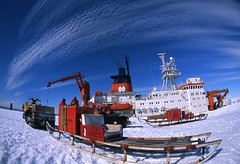
Polarstern SpiegelungThe Arctic has received a great deal of attention over the past couple of years, due to a diminishing summer ice-sheet that is expected to be all but gone within a few years. Climate fear-mongers are crying that the end of the world is nigh, sighting the opening of the Northwest Passage for the first time in known history as its proof.

However, take a trip down to the southern hemisphere – which I know, for many, is a weird idea, considering that surely the northern hemisphere is the important one – and you’ll see that life isn’t all that dire.

The Alfred Wegener Institute for Polar and Marine Research vessel Polarstern has returned to its port in Punta Arenas, Chile, after its latest expedition down south. As part of the International Polar Year 2007/2008, the Polarstern – meaning polar star – expedition ANT-XXIV/3 was focused on examining the oceanic circulation and the oceanic cycles of materials that depend upon it.

Two of the main projects in the Antarctic for the IPY took place aboard the Polarstern; CASO (Climate of Antarctica and the Southern Ocean) and GEOTRACES.

CASO’s intent was to provide “an integrated and interdisciplinary approach to understanding the role of Antarctica and the Southern Ocean in past, present and future climate.” Under the leadership of Dr Stephen Rintoul and Dr Eberhard Fahrbach, the team of 58 scientists from ten countries were on board the Polarstern to study ocean currents, distribution of temperature, salt content and trace substances in Antarctic sea water. Polarstern

"We want to investigate the role of the Southern Ocean for past, present and future climate," chief scientist Fahrbach said. The sinking water masses in the Southern Ocean are part of the overturning in this region and thus play a major role in global climate. "While the last Arctic summer was the warmest on record, we had a cold summer with a sea-ice maximum in the Antarctic. The expedition shall form the basis for understanding the opposing developments in the Arctic and in the Antarctic," Fahrbach said.

GEOTRACES on the other hand, is an ‘international study of the biogeochemical cycles of Trace Elements and Isotopes in the Arctic and Southern Oceans.’ Under the helm of Ed Urban, Ph.D., Robert Anderson and Gideon M. Henderson, their mission was – to quote from the official GEOTRACES website – “To identify processes and quantify fluxes that control the distributions of key trace elements and isotopes in the ocean, and to establish the sensitivity of these distributions to changing environmental conditions.”

The GEOTRACES mission onboard Polarstern was only one of several, the majority taking place in the northern hemisphere. However in their results from the Southern Ocean, the team found the smallest iron concentrations ever measured in the ocean.

The Helmholtz Association of German Research Centres press release noted that “As iron is an essential trace element for algal growth, and algae assimilate CO2 from the air, the concentration of iron is an important parameter against the background of the discussion to what extent the oceans may act as a carbon sink.”

polarstern_orNot surprisingly, these results – from both GEOTRACES and CASO – are only preliminary, and nothing solid will be able to be taken from them for a few years. Oceanic changes must be measured over several years, and also differ spatially, thus the data acquired during this latest Polarstern expedition are not enough to discern long-term developments.

This is why part of the Polarstern expedition was to leave behind more automated buoys.

"As a contribution to the Southern Ocean Observation System we deployed, in international cooperation, 18 moored observing stations, and we recovered 20. With a total of 65 floating systems that can also collect data under the sea ice and are active for up to five years we constructed a unique and extensive measuring network," Fahrbach said.

Either way, over the next few years, the Polarstern – in tandem with scientific teams from around the world – is going to be a focal point of research that will hopefully, provide us with answers to help protect our planet.