

Photo: the robes of monks
Monk robes drying in the sun in Laos. Photo by: Rhett A. Butler, 2009. More photos of the people of Laos.
U.S. tax credits for rainforest conservation abroad? – conservation links for Sept 30, 2010
Obama: We may need to solve climate change in ‘chunks’ Grist One of the brightest possibilities is permanent tax credits for carbon sequestration through the protection and restoration of forests and wetlands and shifts to sustainable agriculture. These tax credits can pay enormous dividends at low cost: by helping reduce tropical deforestation, they’ll cut the source of 15 of global carbon pollution, more than all the cars,...

Photo: the red howler
A red howler monkey howls in Amacayacu National Park in Colombia. More photos of red howler monkeys
Extinct species reappear – conservation links for Sept 29, 2010
Deforestation Enriches a Few While Millions Pay the Price Jakarta Post Indonesia has one of the highest rates of deforestation in the world, and the loss of government revenue associated with illegal deforestation has been estimated at $100 million in East Kalimantan alone. Corruption and deforestation fuel horrific trade in African primates The Ecologist In a remarkable and harrowing dispatch from Guinea-Bissau, Dawn Starin reveals...
Melting ice spawns walrus refugees – conservation links for Sept. 28, 2010
Old Trees May Soon Meet Their Match New York Times Flood-hit Pakistan seeks priority access to climate change aid AlertNet Walruses Swarm Beaches as Ice Melts National Geographic Revealed: the secret world of the panda...

Photo: Forest canopy near Mount Tamalpais, California
Dispea Trail in Marin County, California

Degradation is in the Eye of the Beholder
In the discussion about where oil palm and other plantations should go we talk so easily about degraded lands. But the concept is not straightforward. When the US and Europe cleared their forests a few centuries ago, they did so to “improve” the land. Forests were seen as a source of lumber, best to be cleared and replaced by annual crops with which a lot more money could be made. We have learned since then, and now...
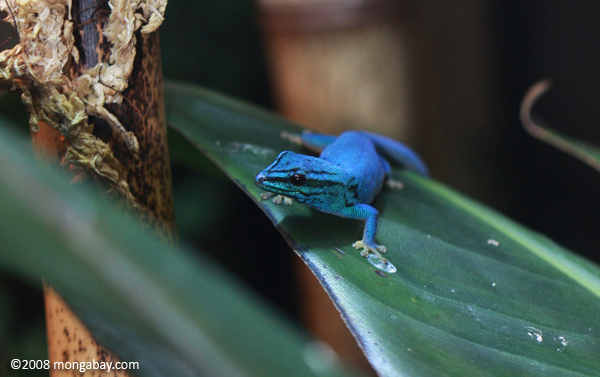
Photo: blue gecko!
Tanzania blue gecko (Lygodactylus williamsi) (photo by Rhett A. Butler). A spiny-tailed house gecko hangs out in Thailand (photo by Rhett A. Butler). To see more photos of reptiles and amphibians in...
Mammoth ivory puts elephants at risk – conservation links for Sept. 27, 2010
Ancient find poses threat to elephants The Sunday Times Mammoth tusks being used to launder elephant ivory? Sawawak to buy troubled Bakun dam The Borneo Post Do Sarawak taxpayers want to pay for this white elephant? Green SURF energy options consultant heads to World Bank Green SURF Fate of controversial coal plan remains...

Photo: the World’s largest lily pad
Amazon water lilies in Colombia. More photos of Queen Victoria water lilies in Colombia The Queen Victoria water lily (Victoria amazonica), named in honor of Britain’s Queen Victoria, is native to the Amazon River basin. It is characterized by a large leaf that is up to 3 m (10 ft) in diameter, on a stalk 7–8 m (23-26 ft) in length. The leaf of Queen Victoria water lily can support up to 70 pounds distributed across its surface,...
Chinese Whispers in Indonesian Conservation
Why do we measure deforestation rates in number of football fields lost? This is causing major confusion.

Photo: Peat forest in Borneo being drained for oil palm plantations
Airplane view of peatland being drained and cleared in Borneo.

Avatar Firmly Keeps the Con in Conservation
Erik Meijaard explains why he thinks that Avatar-like solutions are particularly helpful in conservation.
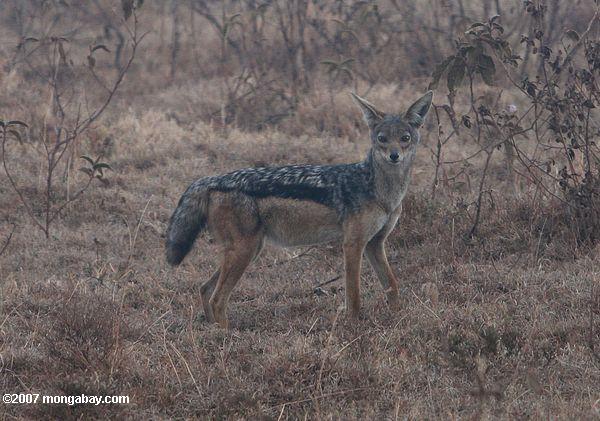
Photo: Black-backed jackal
Black-backed jackal in Tanzania’s Ngorongoro Crater. Photo taken by Rhett A. Butler in 2007
Forests and how to save them: A special report on from The Economist
A special report on forests from The Economist The world’s lungs Better REDD than dead Seeing the wood Money can grow on trees Keeping it in the community Not a small problem The long road to sustainability Less smoke, less ire Something...


Mining giant calls for carbon tax – conservation links for Sept. 22, 2010
Australian miner backs case for carbon tax Reuters Beautiful macro pictures of insects The Telegraph UN’s biodiversity plans hit snag Agence France-Presse Are Frogs Injurious Species? Scientific American Temporary land art on Siberia’s Lake Baikal MutualArt.com BNP Paribas and Wildlife Works Ink $50 million REDD Deal Ecosystem...

Photo: Which birds bring down airplanes?
Bird strikes, as we saw from the “miracle on the Hudson,” have the potential to be extremely dangerous. While typically the result is not as catastrophic, birds and other wildlife strikes to aircraft annually cause over $600 million in damage to U.S. civil and military aviation each year. Yet in order to deal with those strikes and reduce the chances of future ones, airport authorities must know what species are being hit. That’s where the Smithsonian Institution’s Feather Identification Lab comes in.
Conservation links for Sept 21, 2010
International Day Against Tree Monocultures Global Justice Ecology Project Shifting to a green economy can hasten development, says new UN report UN News Before long, it won’t just be Peru’s mountains that are high and dry The Guardian Pepsi, Coke Report on Water Conservation TriplePundit BIOTROPICA Special Section: 2010 International Year of Biodiversity...
