Author Archive

Tasmanian devil populations severely diminished by bizarre cancer

Tuesday, January 8th, 2008

The Tasmanian devil, that iconic marsupial predator of the Australian state of Tasmania, may soon meet its end. A surprising one. Once common throughout the continent, it is believed that devils became relegated to Tasmania sometime after the introduction of the dingo to Australia by Austronesian traders 2,000-3,500 years ago. Now foxes have been intentionally and foolishly brought into Tasmania which is dealing a huge blow to the devil population. However, something else may extinguish the Tasmanian devil before the foxes ever get to it…

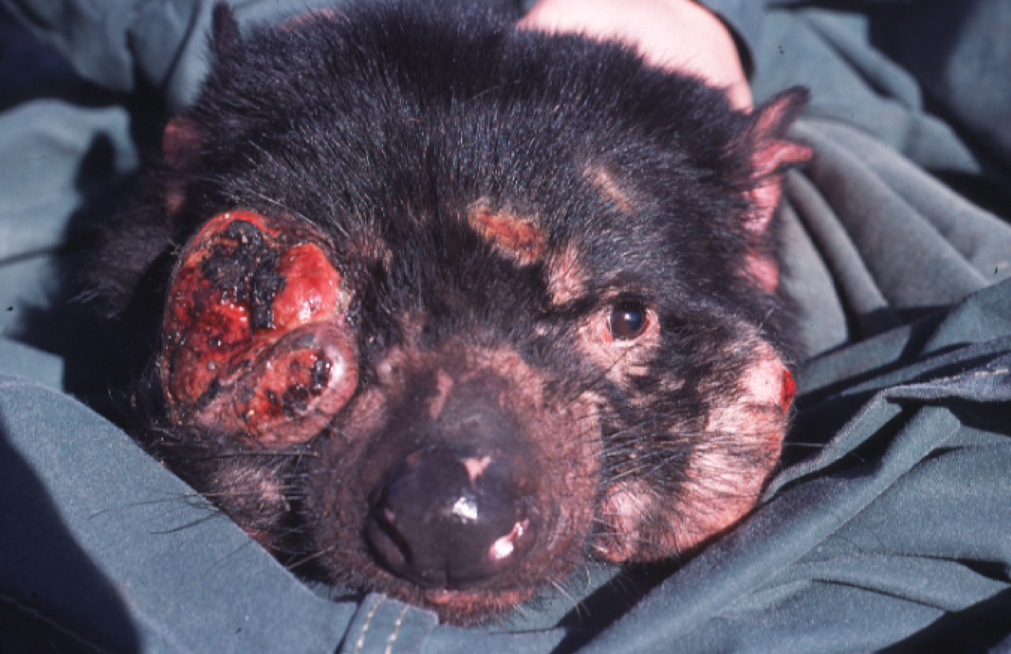
An extremely rare (some call it completely new) form of cancer is spreading alarmingly quickly across Tasmania, inflicting Tasmanian devils with rapidly proliferating facial tumors. The end result is death by starvation. The really bizarre part of this is that this is an infectious cancer, probably passed on as Tasmanian devils scavenge the bodies of others. This was determined when it was discovered that the disorganization of the cancerous cells’ chromosomes in multiple individuals all had pretty much identical character, and that a unique marker present in one of the devil’s normal cells was absent in its cancerous cells. This is definitely NOT normal for cancer. And extremely scary. It’s not one of those cancers that arises spontaneously in one individual and stays in that individual; it’s not even something passed genetically from generation to generation. It’s passed ambiently, spreads quickly, and kills in a matter of months. In ten years, it’s killed anywhere between 20% and 50% of all Tasmanian devils living on the island, with about 60% of the island affected. High density populations have a reported 100% mortality rate within 12-18 months. This has elevated its conservation status from “lower risk/least concern” in 1996 to in 2006 being at risk of extinction in the “medium term”.

There are a number of projects being conducted by the University of Tasmania in effort to discover more about the disease/stop it. It’s all pretty expensive, so donations are welcomed. Go to http://www.tassiedevil.com.au/help.html to find out more.

(photo by Menna Jones)

Does cryptozoology deserve its bad reputation? Probably.

Saturday, January 5th, 2008

Platypus OkapiCoelacanthHomo floresiensis Chupacabra

To almost everyone, cryptozoology does not belong in the scientific world. It relies extensively on anecdotal evidence, is known to fall headlong into hoaxes, and includes Loch Ness Monster fanatics and those people who were convinced that that poor, dead, hairless coyote was a Mexican Goat Sucker. There are thousands of online communities devoted to Bigfoot, some of which organize large expeditions into the woods which, as far as I’ve read, haven’t resulted in anything but the opportunity for these people to get together and impress each other with their expensive night-vision goggles and infrared cameras. And it’s not as if there aren’t new species to be discovered; there are tons of them - mostly insects, plants, and microscopic organisims - but cryptozoology focuses on only the pop-macrofaunal end of the spectrum, leaving the ants and mosses to others, well, more qualified.

That said, the persistence of cryptozoology (and the deep pockets of its wealthier members) has paid off more than once. The okapi, a short-necked, forest-dwelling relative of the giraffe, was regarded by Europeans as an African myth until the British governor of Uganda caught a glimpse of it in 1901.
When the platypus was discovered by Europeans in 1798, the specimens sent back to England were quickly declared fabrications; it took years of ardent persuasion for those in Australia (and fans in Europe) to convice the rest of the world that this strange little egg-laying mammal was indeed real.
The coelacanth, a massive relative of lungfish and tetrapods, was believed to have been extinct since the end of the Cretaceous until one was caught off the coast of South Africa in 1938. Since then it’s come to light that many native communities that line the eastern coast of Africa have for generations used the coelacanth for everything from a source of food to kind of sandpaper.
And then there’s Homo floresiensis, a dwarf form of Homo erectus, the discovery of whose bones on the Indonesian island of Flores in 2003 may have been foreshadowed by references to miniature people in the legends of the island’s natives.

Okapis, platypuses, coelacanths, and floresiensi all had their proponents well before their existence was proven to the world. Of course, so does the Abominable Snowman. Perhaps the lesson here is that real scientists should think about looking for the grain of truth in anecdotal evidence before disounting it altogether, and cryptozoologists should maybe, just maybe, rid themselves of crackpots stop blowing up that grain past any conceivable context.