

Reporter’s Journal: Bomb Harvest
Porters sort and tally a week’s worth of landings from a bomb fishing crew before carrying the catch to the docks in Makassar, Indonesia. Each plastic basket is worth Rp. 100,000 ($8). The full tally for this boat was Rp. 18,800,000 or $1404. The porters get paid a percentage for shuttling the catch to shore and selling the fish to wholesale distributors in the city. This photo was taken by Mongabay.org’s Special Reporting...

A Field Guide to the Larger Mammals of Tanzania – book review
By Gabriel Thoumi A Field Guide to the Larger Mammals of Tanzania provides the most up-to-date guidebook for trekking in Tanzania. It includes detailed species accounts and delightful photos of 135 of the larger mammals of Tanzania. It is the first book to include both marine mammals and recently discovered species of Tanzania. While Tanzania has over 340 recorded mammal species, over 200 of these are rodents, bats, and shrews. For...
The Amazing World of Flyingfish – book review
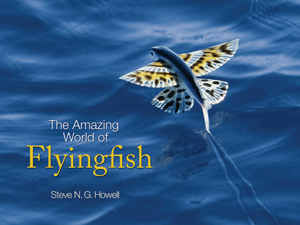
By Gabriel Thoumi Do you remember when you were a kid and you heard about flyingfish for the first time? I do. I was amazed. Fish that could fly! I wondered how far they flew and if they flew for real. The first time I saw flyingfish in person, I had the good fortune to be sailing 3,000 miles across the Atlantic Ocean, south to north. We were giddy with delight to see these amazing small fish of the sea. In The Amazing World of...

Reporter’s Journal: A Wood & Glass View
Wood and glass goggles used by traditional divers throughout Sulawesi. Though produced near-exclusively by the Bajau sea gypsies, “traditional” goggles are commonly used, regardless of ethnic group, when spear-fishing, cyanide fishing or collecting sea cucumbers, groupers or fish killed with bombs that are detonated underwater. However rubber recreational dive masks are becoming more prevalent. This photo was taken by Mongabay.org’s...

A Sparrowhawk’s Lament: How British Breeding Birds of Prey Are Faring– book review
By Gabriel Thoumi Great Britain is known as a nation of birdwatchers – or twitchers – who will travel to great lengths to conserve bird habitat and to observe birds in the wild. Yet in certain circumstances, Great Britain’s birds of prey are persecuted. This cultural dichotomy is explored in wonderful detail in A Sparrowhawk’s Lament: How British Breeding Birds of Prey Are Faring. Great Britain has 15 species of birds of prey,...

Reporter’s Journal: Times are getting dark
By Mongabay Special Reporting Initiative Fellow Ruxandra Guidi. Photo by Roberto Guerra. This is the season of hurricanes and heavy storms. But the archipelago of Kuna Yala, located south of the hurricane belt, is typically spared the damage and strong winds that hit islands further north in the Caribbean, year after year. In recent years, however, rains have forced the people living in these islands — an estimated 30,000 — to start...

Birds of Kenya’s Rift Valley – book review
By Gabriel Thoumi Birds of Kenya’s Rift Valley is another Adam Scott Kennedy tour de force! Following up on the Kennedys’ series of bird and mammal books for Kenyan and Tanzanian travelers, previously described here on Mongabay.com. The Birds of Kenya’s Rift Valley is ideal for the traveler on safari visiting the Rift Valley’s national parks, such as Lake Nakuru, Lake Bogoria, Mount Longonot, and Hell’s Gate. The...

The Extreme Life of the Sea – book review
By Gabriel Thoumi The Extreme Life of the Sea, written by father and son team Stephen R. Palumbi and Anthony R. Palumbi, is simply a tour de force, a splendid must read for any natural history enthusiast. In The Extreme Life of the Sea, we are taken through the challenges of the Earth’s oceans. From its great depths and abysses to extreme pressures and anaerobic environments, and in each location, we learn about the remarkable...

Reporter’s Journal: In Search of Sardines
Community members crowd aboard a slerek purse-seiner in Muncar, East Java, the morning after a successful sardine fishing expedition. University of British Columbia researchers calculated that nearly half the landings in Muncar are distributed to the crew, their relatives, and their neighbors, to eat at home or sell. Though an insurance for protein-rich diets among the local community, the practice means that commercial sardine sales...

Bumble Bees of North America – book review
By Gabriel Thoumi Bumble bees are remarkable. Domesticated bee colonies used for agriculture pollination is a global industry worth at least tens of billions annually. Roughly 20 percent to 30 percent of all food consumed in North America relies upon bumble bee pollination. About 80 percent of European crop species require insect pollination. In parts of China, because of the disappearance of bumble bees, pollination of apple and pear...

Reporter’s Journal: Infant Shrimp
A technician checks on week-old shrimp larvae or nauplius, at the world’s largest shrimp and mollusk broodstock center in Bugbug, Indonesia. The center hopes to become a major supplier inexpensive and healthy “parent” shrimp to Indonesia’s domestic shrimp farming industry, to reduce reliance on pricier and occasionally disease-ridden imports from abroad. Indonesia is one of a handful of shrimp-producing countries unaffected by...

Reporter’s Journal: Fishermans’ Wives
Fishermens’ wives negotiate a price for freshly caught sardines in Negara, a town on the shores of the Bali Strait. The strait is about to become Indonesia’s first region to be managed under an ecosystem-based approach to fisheries management. This photo was taken by Mongabay.org’s Special Reporting Initiatives fellow Melati Kaye, who is reporting on the state of the fishing industry in...

Reporter’s Journal: from the fish warehouse
A worker packs Leopard Coral Grouper in a warehouse in Makassar, Indonesia. Indonesia is one of the world’s largest suppliers of live reef fish, mostly to East Asian markets. Though selling live reef fish is legal in Indonesia, many of the fish are caught illegally using cyanide. This photo was taken by Mongabay.org’s Special Reporting Initiatives fellow Melati Kaye, who is reporting on the state of the fishing industry in...

BBC World Service: Climate Change and Community Forest Management in Kuna Yala, Panama
Mongabay SRI Fellow Ruxandra Guidi published a seven-minute segment on BBC World Service’s Science in Action program. The piece focuses on the indigenous Kuna of Panama, whose livelihoods and homes are already being affected by sea level rise and climate change, and the ways in which they are adapting to it while trying to preserve their customs and sovereign control of their forests. Listen to the full segment...

The allure of the Amazon: real or imagined?
Commentary by Nick Werber What is it about the Amazon that fires the imagination? For as long as I can recall it has been a symbol for the Earth as it wants to be; a flourishing paradise perhaps, a place of explosive variegation, the jungle in full bloom. Like the untamed areas outside of the cities in Brave New World, The Heart of Darkness and The Lost World, the jungle has formed an archetype for all that is natural and untouched by...

Reporter’s Journal: Telling Fiji Time
The expression “Fiji Time” is commonly used among locals and expatriates. From my island experiences, it feels as though I could insert the name of any small island before the word, “time.” But Fiji time seems to also refer to time spent on the obligatory rituals that allows one to enter a village, be accepted, and talk more intimately with the people who belong to it. Aside from navigating the proper customary channels for permission...

Reporter’s Journal: From Panama
By SRI Fellow Ruxandra Guidi Don Jesus was tasked with the logistics for the conference, and Don Feliciano would be taking care of all the meals for more than 25 people. This was no small feat for these two septuagenarian men, who had to do a lot of phone calling and running around in order to try to secure things like ice and a motorboat and a generator. In the end, ice was the only thing they couldn’t get — and that’s because...

Reporter’s Journal: Fighting poachers and Mother Nature
Fijians communities are largely in charge of managing their waterfront. Volunteer fish wardens in the village, appointed by the chief or the Minister, are the only official members of a village who can legally stop poachers. Though they rarely have any equipment to enforce protection of their tabus (swaths of temporarily protected marine areas inside their fishing grounds), they are harder pressed to fight the effects of climate...

Reporter’s Journal: The Lesser Fish
In Fiji’s capital city of Suva, middlemen buy directly from the fishers. The majority of the fish arrive early Saturday morning, indicating many of the reef fish are caught at night while many fish are asleep, making them easy targets for spearfishers. In the past, larger quantities of fresh fish was available daily. Now the sellers make fewer catches stretch across the week. The overwhelming concern about the region’s...

Reporter’s Journal: The forests of Uganda
In late January through early February I traveled to Uganda as part of the first Mongabay Special Reporting Initiative (SRI) to report on “the next big thing in tropical forest biodiversity conservation.” I’m a world traveler, and I have a special passion for tropical rainforests — having seen them in Australia, the Peruvian Amazon, Asia, and Central America. Africa was my last continent to visit (OK, does...
