
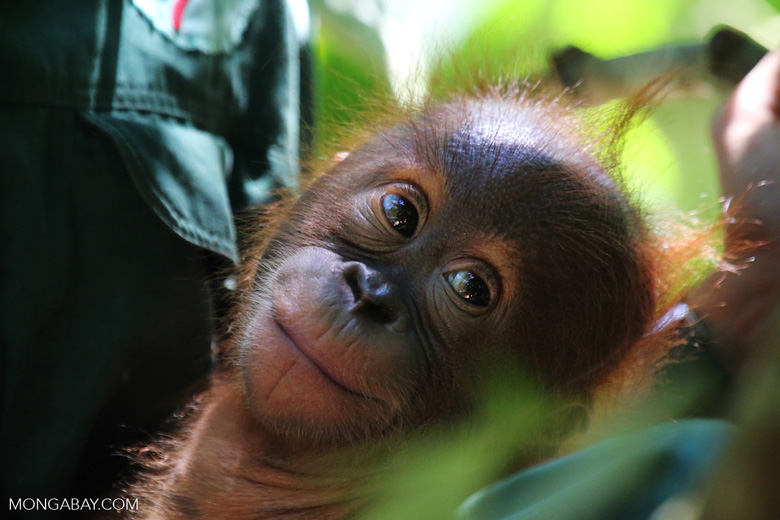
Orphaned orangutan (photo)
Baby orangutan orphaned by the palm oil industry when its forest habitat was cleared for a plantation in Sumatra. More orangutan photos.

Colorful katydid in New Guinea (photo)
Katydid nymph in a tract of forest near Manokwari in West Papua, Indonesian New Guinea. More photos of katydids.

Reporter’s Journal: Bomb Harvest
Porters sort and tally a week’s worth of landings from a bomb fishing crew before carrying the catch to the docks in Makassar, Indonesia. Each plastic basket is worth Rp. 100,000 ($8). The full tally for this boat was Rp. 18,800,000 or $1404. The porters get paid a percentage for shuttling the catch to shore and selling the fish to wholesale distributors in the city. This photo was taken by Mongabay.org’s Special Reporting...

Reporter’s Journal: A Wood & Glass View
Wood and glass goggles used by traditional divers throughout Sulawesi. Though produced near-exclusively by the Bajau sea gypsies, “traditional” goggles are commonly used, regardless of ethnic group, when spear-fishing, cyanide fishing or collecting sea cucumbers, groupers or fish killed with bombs that are detonated underwater. However rubber recreational dive masks are becoming more prevalent. This photo was taken by Mongabay.org’s...

Reporter’s Journal: In Search of Sardines
Community members crowd aboard a slerek purse-seiner in Muncar, East Java, the morning after a successful sardine fishing expedition. University of British Columbia researchers calculated that nearly half the landings in Muncar are distributed to the crew, their relatives, and their neighbors, to eat at home or sell. Though an insurance for protein-rich diets among the local community, the practice means that commercial sardine sales...

Reporter’s Journal: Infant Shrimp
A technician checks on week-old shrimp larvae or nauplius, at the world’s largest shrimp and mollusk broodstock center in Bugbug, Indonesia. The center hopes to become a major supplier inexpensive and healthy “parent” shrimp to Indonesia’s domestic shrimp farming industry, to reduce reliance on pricier and occasionally disease-ridden imports from abroad. Indonesia is one of a handful of shrimp-producing countries unaffected by...

Reporter’s Journal: Fishermans’ Wives
Fishermens’ wives negotiate a price for freshly caught sardines in Negara, a town on the shores of the Bali Strait. The strait is about to become Indonesia’s first region to be managed under an ecosystem-based approach to fisheries management. This photo was taken by Mongabay.org’s Special Reporting Initiatives fellow Melati Kaye, who is reporting on the state of the fishing industry in...

Reporter’s Journal: Disappearing Home
By Melati Kaye A boy takes in the sunset on Barang Lompo, one of the Spermonde Islands in Indonesia. The loss of local reef cover from destructive fishing practices and soil runoff from the nearby city of Makassar exposes islands like Barang Lampo to extreme weather. Over the last thirty years, this tiny island, like others in the region, has lost a tenth of its landmass from the erosive force of storm surges and increasingly larger...

Reporter’s Journal: Dock Boys
By Melati Kaye “Dock boys” take a swim break from sorting and carrying fish at Makassar’s Paotere harbor, where fish caught with hook and line, homemade bombs, and cyanide are brought to port and sold. This photo was taken by SRI fellow Melati Kaye, who is reporting on the State of Indonesian Fisheries.

Reporter’s Journal: a different kind of leopard
By Melati Kaye March is leopard coral grouper season in South Sulawesi’s Spermonde islands. The live fish sell for $30 per kilogram. Dead fish fetch less than a third of that price. Careful hook and line fishermen can sometimes manage to keep their catch alive. But a surer method is to stun the fish with cyanide, an illegal but widespread practice. This photo was taken by Mongabay.org’s Special Reporting Initiatives fellow...

Indonesians working together to save Sumatran tigers
Reader contribution by Matthew S. Luskin Indonesians are committed to ensuring the persistence of Sumatran tigers. The gamut of island-wide conservation efforts was discussed this week in Padang, West Sumatra, during the annual meeting of HarimauKita (harimau means “tiger” in Indonesian), which brought together a consortium of stakeholders for Sumatran tiger conservation. Members worked late into each night to coordinate and evaluate...

Sneaky Snakes in Indonesia
A shocking 449 species of reptiles call Sundaland home, of which 249 are endemic to the region. Indonesia has an extremely high level of biodiversity, which is most likely due to the great size and tropical archipelago make-up of the land. The Indonesian fauna is so vivid, that the colors of these snakes actually camouflage them into the background. Each of these snake’s coloring has evolved to blend in with where it tends to...


Picture: rainforest on Peucang Island, off West Java, Indonesia
Rainforest tree on Peucang Island. More pictures of Peucang Island.
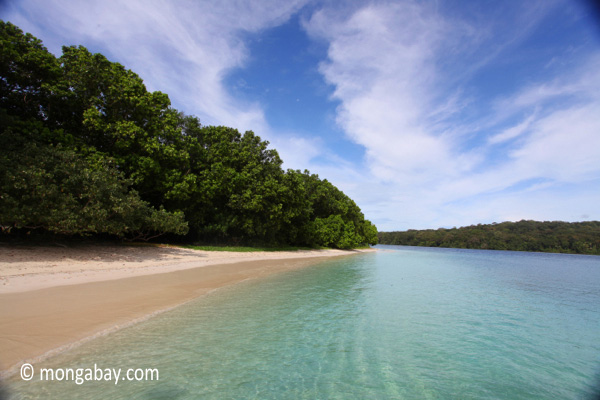
Picture: tropical beach in Indonesia
The beach on Peucang Island, Java. Photo by Rhett A. Butler.
Astroturf campaign by the Consumer Alliance for Global Prosperity suffers defeat
A campaign by the Consumer Alliance for Global Prosperity, a group that campaigns on behalf of Asia Pulp and Paper’s interests in the United States, failed to stop Kroger from banning APP’s paper products from its stores. Kroger, America’s largest grocery store, on Thursday said it would no longer sell Asia Pulp and Paper (APP) products due to concerns over deforestation. The move came after Greenpeace targeted Kroger,...

Girl Scouts fighting palm oil receive wider media coverage (video)
After five years of campaigning, two Girl Scouts fighting palm oil in Girl Scout cookies are receiving wider media coverage this week after meeting with heads of Girl Scouts of the US. The organization has now agreed to research different options, such as sustainably-grown palm oil or using another ingredient, reports the Wall Street Journal. Above, the Girl Scout activists are interviewed on the CBS Early Show. For more information:...
Pictures: Primary forests included, secondary forests excluded in Indonesia’s moratorium
This week Indonesia officially signed a moratorium on the granting of new logging and plantation permits in primary forests and peatlands. Secondary forests are excluded from the measure.
Pictures of baby animals with their mothers for Mother’s Day
Mother tarsier and baby on the island of Sulawesi in Indonesia. Photo by: Rhett A. Butler. Mother and baby orangutan in tree in Sumatra. Photo by: Rhett A. Butler. Mother Panamanian golden frog with green baby. Photo by: Rhett A. Butler. Southern Tree Hyrax with baby in Kenya. Photo by: Rhett A. Butler. Baby crowned lemur clinging to its mother in Madagascar. Photo by: Rhett A. Butler. Mother Agouti (Dasyprocta punctata) with babies...

Photos: up close and personal with Sumatran elephants
Baby Sumatran elephant on the run. Photos of Sumatran elephants at Bukit Barisan Selatan National Park on the island of Sumatra. These Sumatran elephants are patrol elephants; they’ve been recently domesticated and are used to reduce human-wildlife conflict. All photos by Rhett A. Butler. Meeting of the minds. Sumatran elephant with mahout. Trunk tricks. Traveling. Big male. Fountain. Modern world. To see more photos of Sumatran...
